1After320, Delhi, an alternative space, invited me to use their space as a studio for three months as a part of their Artist Process programme in 2016. The space had previously functioned as a storage area for artworks and still retained those characteristics. I approached this condition as an opportunity to think of the entire architecture as my canvas- not merely as a two-dimensional surface, but as a three-dimensional space that could be drawn into and engaged with. Dividing the entire area into two sections- one a multi-dimensional canvas for spatial intervention, and another as my thinking space.
Line Drawing
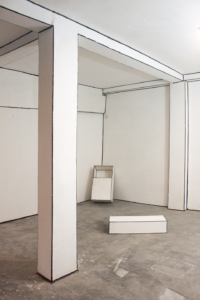
Black Paint on Wall
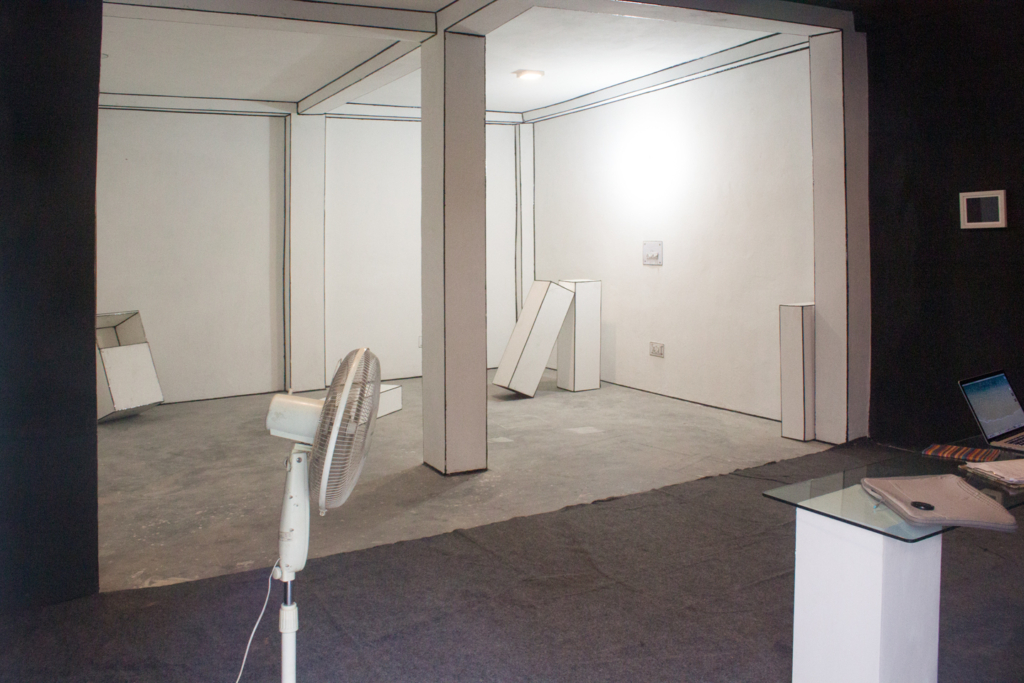
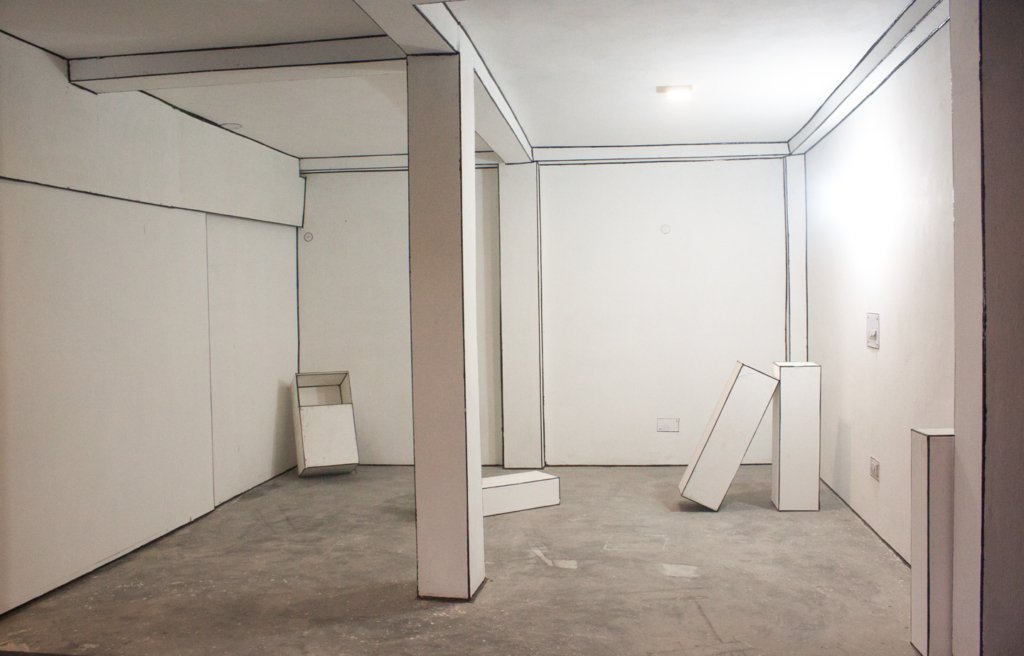
The project included five different engagements with the architectural site, out of which the Line Drawing was the first one. Developed as an exercise in understanding the poetics and spatial narrative of the space, the site was transformed into a sketchbook page when viewed from a distance, and akin to a cardboard model when one physically enters it.
Since working with lines has been central to my practice at that time, I began by looking closely at the existing lines within the architecture- its structural edges, corners, and composite elements, both fixed and temporary, all of which were highlighted with black paint. Through this act of simply outlining what was already visible, the solid concrete architecture began to lose its sense of permanence and appeared to be transfigured into something lighter and provisional, creating a strange confusion of materiality. The work explores how a minimal intervention can fundamentally alter our understanding and experience of architectural space.
For more images https://parulguptastudio.com/work/making-space-line-drawing/
Notes on Movement: Performative Drawing
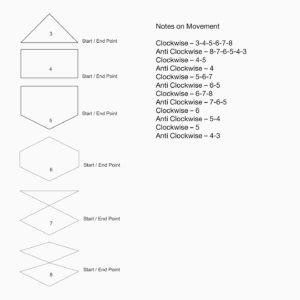
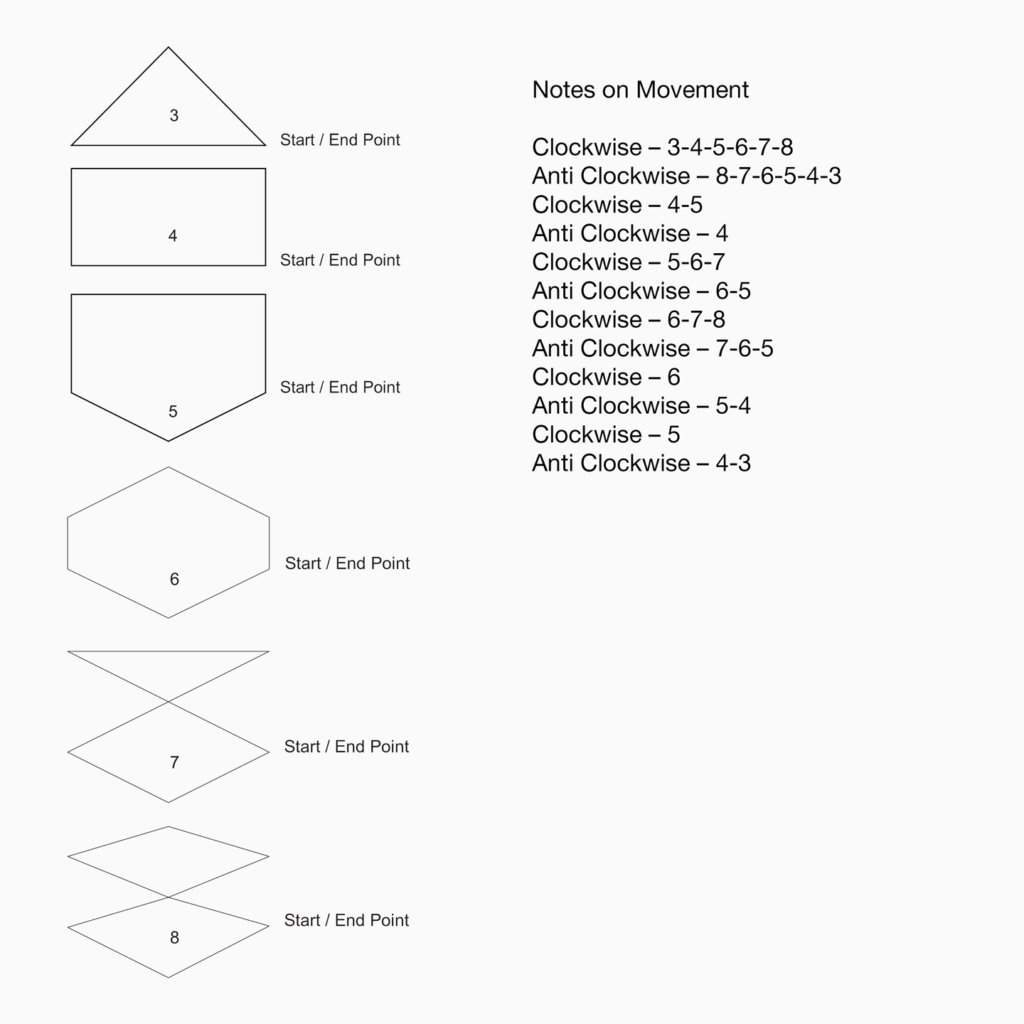
During the three-month engagement with the site, the architectural space was approached not merely as a location for display, but as a generator of new ways of thinking, making and interacting. There has always existed a conventional knowledge, a subconsciously guided way of navigating and moving from point A to B within these architectural spaces. Wherein, the architecture inherently guides the temporal body through prescribed paths and habitual modes of movement, shaping up how one instinctively navigates. This predetermined relationship between body and space fascinated me, since I was struggling to create those in-between spaces for others to experience what I had been experiencing myself, i.e. the simultaneous creation and erasure of forms. Seeking to momentarily disrupt these embedded patterns and open up alternative modes of spatial experience, it became a point of departure for the work and eventually led to a performance-based drawing in the series Notes on Movement, titled Notes on Movement- Performative Drawing.
Made within the three-dimensional space constructed at 1After320, Notes on Movement emerged from an enquiry into the transient forms that continually emerge and disappear within the mind of viewers. It was built upon a concealed set of precise instructions.
Alternating between clockwise and counter-clockwise movements, the work unfolded as a live drawing enacted through the movement of a body within space. Geometric forms were continuously created and erased through the performance itself. The viewer, while watching the performance, could see it becoming and being erased at the same time, as there are no traces of the form left. Every action originated from and returned to the same point, forming a cyclical structure in which the drawing ephemerally existed only for the duration of the said performance and ultimately survived exclusively in the viewer’s memory. Expanding beyond a static mark, the in-flux bodily intervention transformed the drawing into a temporal and embodied experience. And thereby, proposed space itself as a dynamic material, medium and active generator of form.
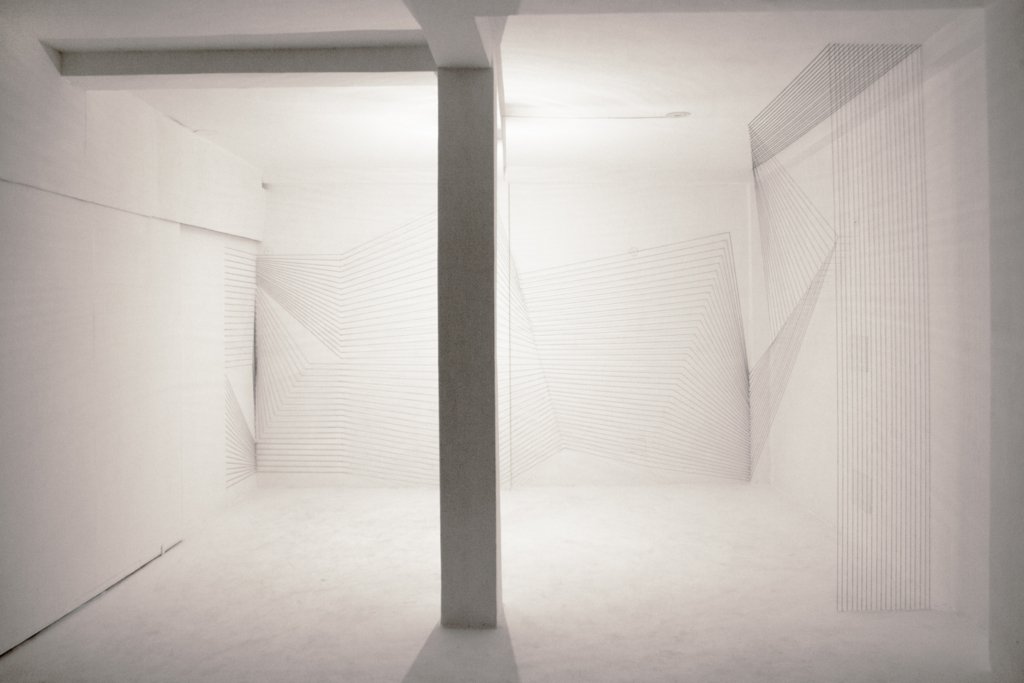
Drawing in Space
Threads, Cycle Spoke, Nails, Permanent Marker on Wall
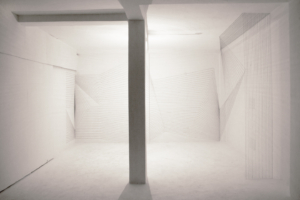
The third engagement within the Making Space project was a site-specific intervention, titled Drawing in Space. The imagined forms and the idea of movement in the project’s initial spatial interventions, particularly from Line Drawing, were carried forward here in this work, where the line becomes the form and further extends itself into the surrounding space. Drawing in Space was a process to understand the relationship between a line drawing and its manifestation in space. This process began with an existing body of work titled Black Drawings, as a familiar point of departure needed to navigate through a space of such a big scale and depth. The challenge was to translate the language of these linear compositions on paper into a three-dimensional environment without merely stretching the lines arbitrarily across the space. Following which, I recreated some of my earlier drawings on paper in the physical space, using threads, cycle spoke, nails and permanent marker on the wall. The work began from one corner rather than the centre, allowing the linear drawing to expand and move organically across the architecture, much like the original compositions that too resisted a centralised placement on paper.
The origins of Drawing in Space series can be traced to 2011, when the idea first emerged during my MA Degree Show at Nottingham Trent University, UK. The experience of watching viewers repeatedly move towards and away from a site-specific drawing within the exhibition space invoked a fundamental question in me: What if the viewer could move into the drawing itself, as though entering a labyrinth? The very question became the conceptual foundation towards developing these works of linear drawing as a three-dimensional and spatial practice.
While the drawings were manually transferred from paper onto the huge physical site, digital mapping via a two-dimensional digital-drawing software, CorelDRAW, was used for not just taking the measurements, but also to visually explore possible extensions of the drawing, such as how much wider could the linear composition be stretched, what angles of threads could be used, or how the gradual placements of needles would be like. Although a 2D software has its constraints, the convenience of a 3D software for complete visualization for the work would have simply removed the possibility of discovery while physically interacting with the site. The excitement therefore lies precisely in not knowing how the real space would physically respond, what forms would emerge, how would a wooden or brick wall respond, or how the materials and surfaces would behave upon engaging with the site. Even the individual cycle spokes vary in their length, size and dimension. Through the use of threads, cycle spokes, nails, and permanent marker, many different drawings on paper were stitched together in a bigger format as per the dimensions, contours and structural elements of the architectural space. The drawing gradually extended across walls, floors and ceilings, stretching, bending, and adapting to the contours and structural conditions of the site. Gradually developing and shaping up the work from drawing on the paper, to digitally drawing on the computer system, to a manual spatial drawing in the physical space and to an active collaboration with the architectural space. Moreover, the viewer could move into the drawing and experience the details, precision, lines and drawing shifting as one moves between multiple positions. Thereby revealing new alignments, shifts, relationships, and allowing the drawing to evolve from a static image into an embodied, spatial experience.
For more images https://parulguptastudio.com/work/making-space-drawing-in-space/
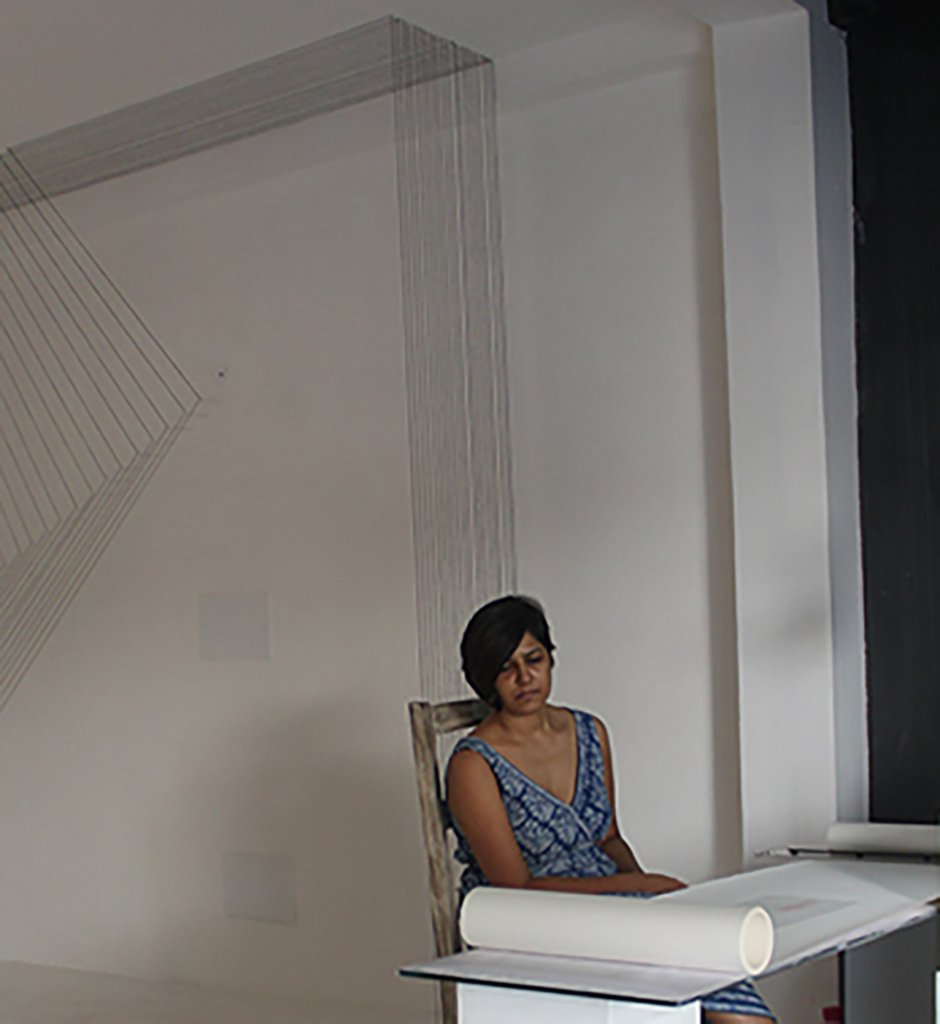

Durational Drawing #1
Ink on Archival paper
Alongside engaging with the physical spatiality of an architectural site, another query gradually emerged in the process: Could time itself be understood as a form of space? Can the logic of containment of physical space be applied to the containment of time? If an architectural space possesses boundaries, duration and underlying structure, could time similarly be contained, traversed and experienced as a spatial entity? This line of questioning resulted in the making of Durational Drawing, an investigation into time as a material and spatial condition.
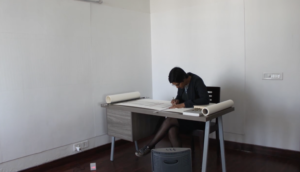
Durational Drawings consists of a continuous linear drawing that was executed over a period of ten consecutive days, where I set myself to draw onto a long paper scroll each day from 10 AM to 6 PM. Governed by a simple yet rigorous process of repetitive mark-making, the drawing became less about composing a predetermined image and more about allowing the duration itself to guide what it would make, and what form it would generate.
Imagined as a linear space in the format of a timeline, its visual composition emerged out of the sustained rhythm of the bodily intervention with the repetition of formal gestures, and evoking a meditative state of being through its process. The work extends an ongoing inquiry into drawing as an embodied practice, where the repetitive actions simultaneously respond to the internal states of mind and the physical act of making. Here, the drawing becomes a record of lived duration, where space and time continuum constitute the fundamental structure that weaves, holds and sustains the work together. Upon completion, the scroll was subsequently divided into five panels according to the compositional rhythms that had naturally emerged.
Note on Artistic Process: The work departs from my pre-existing concerns on drawings -“Drawing on paper reflects a series of concerns prompted by repetitive action, both fuelled by internal (somatic & psychic) and external (drawing & environment) phenomena simultaneously. While making repetitive patterns using the line as form, both mind and body are engaged as machine – moving in methodical, rhythmical motion – mind in a confined space, while the body, aided by two tools (pen & ruler) that while making the straight line endures the pain, heightened by the awareness of the self, the surface and the activity.”
For more images https://parulguptastudio.com/work/durational-drawings/
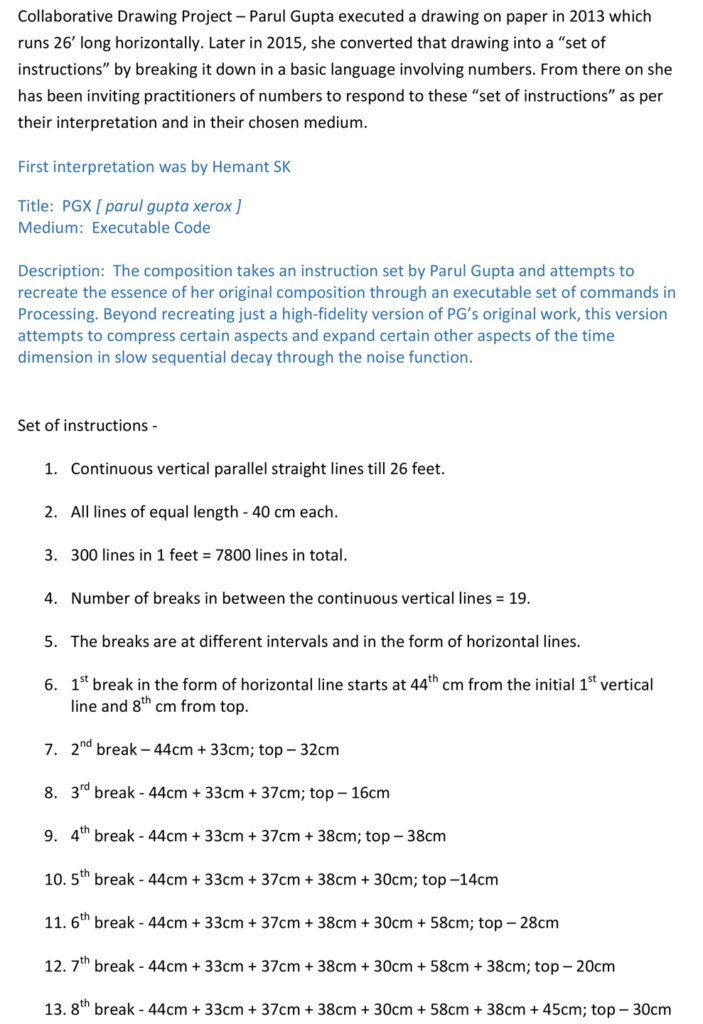
Drawing Lab: PGX by Hemant SK
The residency, furthermore, facilitated an active dialogue with the fellow artists, curators, space management, production team and local community. Such exchanges, rarely encountered within the solitude of a personal studio, became an integral part for the development of my next and final work within the Making Space project..
In one such conversation with the sound artist Hemant SK we started talking about the afterlife of a drawing. It led to the emergence of Drawing Lab, a series of collaborative works which explored the idea of a drawing leaving its original form and becoming something else- capable of being transformed into different forms and translated across media formats.
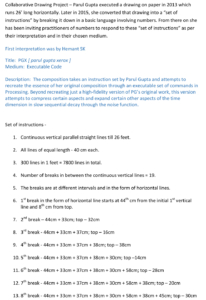
It was a 26 foot long horizontal drawing on paper created in 2013 that served as an entry point into this ongoing project. Rather than sharing the original drawing itself with collaborators, it was translated in 2016 into a coded system of basic numerical instructions, which have since been shared with and engaged by practitioners from diverse fields. The instructions invite them to interpret and reconstruct the work through their own material language and methodologies, thereby molding the drawing into an open system capable of continual transformation.
The first collaborative engagement as part of the Drawing Lab project here was realised with Hemant SK, who interpreted the given instruction-set as an executable digital code using the Processing programming language and processing software. Titled PGX (Parul Gupta Xerox), the work was encoded into a looped digital video format, generating a continuously evolving visual composition. Through compression, expansion and sequential decay, governed by computational noise functions, the work reimagined the original tactile drawing as a living algorithm. Drawing Lab, the larger project, thereby proposes drawing not as a finished object, but as a transferable language that can migrate across media, accumulate new meanings, and continually acquire new forms through collaboration and interpretation.
Descriptive Note by Sound Artist, Hemant SK: The composition takes an instruction set by Parul Gupta and attempts to recreate the essence of her original composition through an executable set of commands in Processing. Beyond recreating just a high-fidelity version of PG’s original work, this version attempts to compress certain aspects and expand certain other aspects of the time dimension in slow sequential decay through the noise function.
Making Space I 1After320 I New Delhi, India
2016